基本信息
书名: Kamishibai Man
作者: by
- Hardcover: 32 pages
- Publisher: HMH Books for Young Readers; First Edition edition (October 24, 2005)
- Language: English
- ISBN-10: 0618479546
- ISBN-13: 978-0618479542
- Product Dimensions: 9.8 x 0.4 x 10.8 inches
编辑推荐
The Kamishibai man used to ride his bicycle into town where he would tell stories to the children and sell them candy, but gradually, fewer and fewer children came running at the sound of his clappers. They were all watching their new televisions instead. Finally, only one boy remained, and he had no money for candy. Years later, the Kamishibai man and his wife made another batch of candy, and he pedaled into town to tell one more story—his own. When he comes out of the reverie of his memories, he looks around to see he is surrounded by familiar faces—the children he used to entertain have returned, all grown up and more eager than ever to listen to his delightful tales.
Using two very different yet remarkable styles of art, Allen Say tells a tale within a tale, transporting readers seamlessly to the Japan of his memories.
作者介绍
Allen Say was born in Yokohama, Japan, in 1937. He dreamed of becoming a cartoonist from the age of six, and, at age twelve, apprenticed himself to his favorite cartoonist, Noro Shinpei. For the next four years, Say learned to draw and paint under the direction of Noro, who has remained Say's mentor. Say illustrated his first children's book -- published in 1972 -- in a photo studio between shooting assignments. For years, Say continued writing and illustrating children's books on a part-time basis. But in 1987, while illustrating THE BOY OF THE THREE-YEAR NAP (Caldecott Honor Medal), he recaptured the joy he had known as a boy working in his master's studio. It was then that Say decided to make a full commitment to doing what he loves best: writing and illustrating children's books. Since then, he has written and illustrated many books, including TREE OF CRANES and GRANDFATHER'S JOURNEY, winner of the 1994 Caldecott Medal. He is a full-time writer and illustrator living in Portland, Oregon.
媒体评论
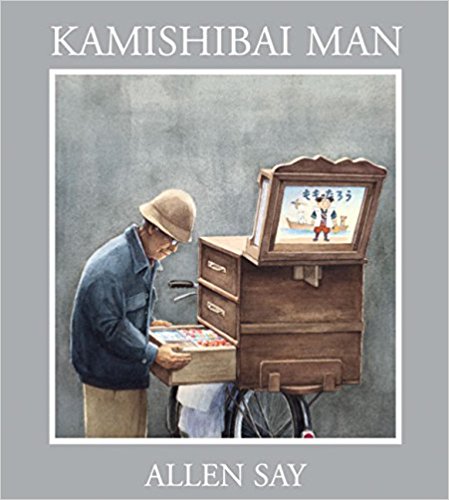
In a foreword, Say explains that Kamishibai means "paper theater" and that years ago Kamishibai men were itinerant storytellers who traveled around Japan on bicycles with a big, wooden box mounted on the back seat. The box contained a miniature theater, and beneath it were drawers of candy that the performer sold to eke out a living. As a storyteller spun his tale, he used picture cards to illustrate dramatic points, finishing each time with a cliffhanger designed to entice the children in his audience to come back another time to hear the continuation of the story. Say's lovely new book is about an elderly Kamishibai man, long retired, who, missing his rounds, decides to pedal back to the old neighborhood for one last performance. The story-within-a-story that emerges reveals why this unique type of performance art has all but disappeared. The quietly dramatic, beautifully evocative tale contains a cliffhanger of its own, and its exquisite art, in the style of Kamishibai picture cards, will attract even the most jaded kid away from the TV to enjoy a good, good book. Michael Cart
Copyright © American Library Association. All rights reserved
借阅记录(近期成交数量0)
还没有人结果买过此书

